

|
ASSESSMENT 3 BRIEF |
|
|
Subject Code and Title |
MIS604 Requirement Engineering |
|
Assessment |
Agile Requirements Analysis and Management Report |
|
Individual/Group
|
Individual |
|
Length |
2000 words (+/- 10%) |
|
Learning Outcomes |
The Subject Learning Outcomes demonstrated by successful completion of the task below include:
b) Demonstrate methods for eliciting, analysing, documenting, and maintaining requirements in an organisational context.
c) Synthesise key principles of requirements management and communicate to stakeholders in order to solve problems.
d) Evaluate organisational requirements to maximise effectiveness and promote sustainable business practices. |
|
Submission |
By 11:55pm AEST/AEDT Sunday end of Week 11/Module 6.1
For Intensive class: By 11:55pm AEST/AEDT Sunday end of Week 6/Module 6.1 |
|
Weighting |
35% |
|
Total Marks
|
100 marks |
Assessment Task
|
This final assessment requires you to respond to the given case study used in Assessments 1 and 2, so that you can develop insights into the different facets of Requirements Analysis and management in the agile approach of software development. In this assessment you are required to produce an individual report of 2000-word (+/- 10%) detailing the following:
o A Product Roadmap for the project
o Product Backlog of coarse granularity including epics and user stories
o Personas who typify the future system end-user
o Identification of epics and user stories to define the Minimum Viable Product (MVP) for the first release o Decomposition of epics into user stories for MVP
o Story mapping for MVP - ordering user stories according to priority and sophistication o Story elaboration of user stories for MVP to ensure that
the user story is clear
o Acceptance criteria for the elaborated stories to ensure the ‘definition of done’
o How the mindset and role of the Business Analyst need to be changed while transitioning from ‘Waterfall’ to ‘Agile’ requirement development and management.
Please refer to the Instructions for details on how to complete this task. |
MIS604_Assessment_3_Brief_Report_Module 6.1 Page 1 of 6

Context
|
In the second assessment, you would have developed capability in the areas of requirements analysis and requirements lifecycle management, which are well recognised Business Analysis skills and capabilities. However, Agile has become a recognised software development approach which is both adaptive and iterative in nature. This has necessitated the development of new and differentiated requirements analysis and management skills, techniques, and capabilities. This assessment aims to assist you in developing well-rounded skills as a Business Analyst
who uses spectrum tools and techniques. In doing so, you can draw irrespective of the approach your future employer may take to software development. |
Instructions
|
• Please read the given case study and make assumptions when needed.
• Based on the given case study, you are required to write a 2000-word Agile Requirements Analysis & Management Report.
• Review your subject notes to establish the relevant area of investigation that applies to the case. Re-read any relevant readings.
• Plan how you will structure your ideas for your report and write a report plan before you start writing. •
The report DOES NOT require an executive summary or abstract.
• Structure of the Report
o A professional custom title page with the subject code, subject name, assignment title, student’s name, student number and lecturer’s name.
o Table of contents
o An introduction (100-150 words) which will also serve as your statement of purpose for the report. This means that you will tell the reader what you are going to cover in your report. You will need to inform the reader of:
1. Overview of the problem you’ve been asked to research
2. The key concepts you will be addressing.
3. What the reader can expect to find in the body of the report
o The body of the report (1700-1800 words) will need to cover two specific areasreflecting the given case study:
1. A Product Roadmap, which includes main product features over releases and timelines of the project
2. Product Backlog of coarse granularity including Epics and User stories (a minimum of ten (10) entries). Following is an example format to create the product backlog:
Backlog Item number Epic/User Story Story Points Priority Status
… … … … …
3. Two (02) Personas who typify the future system end-users or major stakeholders. 4. Identify the epics and user stories to include in the Minimum Viable Product (MVP) for first release. 5. Decomposition of two (02) epics into a number of user stories for the MVP.
6. Story Mapping for MVP - ordering User stories according to priority and sophistication. 7. Story elaboration of four (04) user stories for MVP to ensure that the User story is clear. 8. Acceptance criteria for the four (04) elaborated stories to ensure the ‘definition of done’. 9. Describe, how the mindset and role of a Business Analyst (BA) need to be changed while transitioning from ‘Waterfall’ to ‘Agile’ requirement development and management practice. |
MIS604_Assessment_3_Brief_Report_Module 6.1 Page 2 of 6

|
o The conclusion (100-150 words) will summarise any findings or recommendations that the report puts forward regarding the concepts covered in the report.
o Reference list
It is expected that you perform additional research and provide a minimum of five additional references in the field of agile requirement specification, analysis, and management to add depth to your explanation. All references should accompany DOI or resource link.
o Appendix (if required)
• Report Format and Layout
o The report should use font Arial or Calibri 11 point, should be line spaced at 1.5 for ease of reading and page numbers on the bottom of each page.
o Diagrams and tables must carry the appropriate captioning (numbering, name, and resource). o If diagrams or tables are used, please follow the APA 7th edition guideline.
o Due attention should be given to pagination to avoid loss of meaning and continuity by unnecessarily splitting information over two pages.
• Assessment rubric
You are strongly advised to read the rubric which is an evaluation guide with criteria for grading the assignment. This will give them a clear picture of what a successful report looks like. |
Referencing
|
It is essential that you use appropriate APA style for citing and referencing research. Please see more information on referencing in the Academic Skills webpage. |
Submission Instructions
|
The assessment needs to be submitted in Microsoft Word format. Any other formats will not be accepted. Submit Assessment 3 via the Assessment link in the main navigation menu in MIS604 Requirement Engineering. The Learning Facilitator will provide feedback via the Grade Centre in the LMS portal. Feedback can be viewed in My Grades. |
Academic Integrity
|
All students are responsible for ensuring that all work submitted is their own and is appropriately referenced and academically written according to the Academic Writing Guide. Students also need to have read and be aware of Torrens University Australia Academic Integrity Policy and Procedure and subsequent penalties for academic misconduct. These are viewable online.
Students also must keep a copy of all submitted material and any assessment drafts. |
Special Consideration
|
To apply for special consideration for a modification to an assessment or exam due to unexpected or extenuating circumstances, please consult the Assessment Policy for Higher Education Coursework and ELICOS and, if applicable to your circumstance, submit a completed Application for Assessment Special Consideration Form to your Learning Facilitator. |
MIS604_Assessment_3_Brief_Report_Module 6.1 Page 3 of 6

Assessment Rubric
|
Assessment Attributes |
Fail
(Yet to achieve minimum standard)
0-49% |
Pass
(Functional)
50-64% |
Credit
(Proficient)
65-74% |
Distinction
(Advanced)
75-84% |
High Distinction
(Exceptional)
85-100% |
|
Visual appeal and presentation of content
Title page
Font, spacing and
format are in
accordance assignment requirements.
Appropriate use of
paragraphs, sentence construction, spelling and grammar.
Adheres to the word count requirement
Percentage for this
criterion = 15% |
No title page is included.
Incorrect font and size is used with poor line
spacing.
Report is written as a
block of text with no
breaks in between ideas.
Separate ideas cannot be clearly discerned.
Many errors in spelling or grammar obscure
meaning of what student has written.
Does not adhere to the word count requirement. |
Title page is included but is missing most information.
Either incorrect font and size is used or poor line spacing.
Paragraphs are used but large blocks of text with long
sentences make it difficult to understand the ideas being conveyed.
Spelling or grammar has errors but meaning remains clear.
Does not adheres to the word count requirement. |
Title page is included but is missing key information.
Some errors in font use and line spacing.
One idea or concept per paragraph.
Some paragraphs could be more succinctly written.
Minor spelling or grammar errors.
Adheres to the word count requirement. |
Title page is included with most required information.
Minor errors in font,
spacing and format.
One idea or concept per paragraph with 3-4 well constructed sentences per paragraph.
No errors in spelling or grammar.
Adheres to the word count requirement. |
Title page is included with all required information.
Font, spacing and format are in accordance the
assignment brief.
Expert use of paragraphs with 3-4 well constructed sentences per paragraph
which follow logically from each other.
No errors in spelling or grammar.
Adheres to the word count requirement. |
|
Knowledge and
understanding
Product Roadmap and the Product Backlog
Epics, User stories,
story decomposition and story elaboration.
Story mapping and
Minimum Viable
Product |
Lack of understanding of the required concepts and knowledge.
Key components of the assignment are not
addressed.
Lack of application, and analysis of information to provide clear
recommendations. |
Limited understanding of required concepts and
knowledge.
Some of the key components of the assignment are not addressed.
Limited application and
analysis to provide clear recommendations. |
Adequate knowledge or understanding of the
required concepts. A
reasonable capacity to
explain and apply relevant key concepts.
Supports opinion and
information substantiated by evidence from research to provide
recommendations. |
Thorough understanding of the key concepts.
Discriminates between assertion of opinion and information substantiated by robust evidence from the research/course
materials and extended reading.
Well demonstrated capacity to apply and analyse |
Highly developed
understanding of the field or discipline/s.
Systematically and critically discriminates between assertion of opinion and information substantiated by robust evidence from the research/course
materials and extended reading. |
MIS604_Assessment_3_Brief_Report_Module 6.1 Page 4 of 6

|
Percentage for this
criterion = 60% |
|
|
|
relevant information to provide clear
recommendations. |
Recommendations are
clearly justified based on the application and analysis of information. |
|
Use of academic and discipline conventions
Formal tone
Introduction, body and conclusion.
No use of first party perspective
Appropriate use of
credible resources,
Correct citation of key resources using APA 7 style of referencing, in text as well as for
models, diagrams,
tables or tools.
Percentage for this
criterion = 25% |
Poorly written with
informal tone, using first person pronouns.
Does not adhere to the assignment brief of the requirements for a short business report.
No introduction
attempted. Conclusion not attempted.
Inconsistent and
inadequate use of good quality, credible and
relevant resources to
support and develop
ideas.
No use of in-text
references, or no
reference list at the close of the report.
Many mistakes in using the APA 7 style. |
Written according to
academic genre.
Minor errors in the use of first-person pronouns.
Introduction attempted but very generic does not clearly state the purpose of the report.
Conclusion attempted but does not include summation of key concepts discussed in the report and/or key
conclusions or
recommendations.
Consistent use of credible and relevant research
sources to support and
develop ideas, but these are not always explicit or well developed.
Little use of in-text
referencing, or inadequate references consulted and added to references at the close of the report.
Some mistakes in using APA 7 style. |
Written according to
academic genre.
Consistent use of credible and relevant research
sources to support and develop ideas.
Sound use of the
introduction but does not clearly state either the
purpose of the report or what the reader should expect to find in the body of the report.
Sound use of the conclusion and succeeds in either the summation of key concepts discussed, or key
conclusions or
recommendations, but not both.
Good use of in-text
referencing and
appropriate number of references used and listed in the reference list.
There are only minor errors in using the APA 7 style. |
Well-written and adheres to the academic genre.
Expert use of good quality, credible and relevant
research sources to support and develop appropriate arguments and statements.
Shows evidence of reading beyond the key reading.
Good use of the
introduction which clearly states the purpose of the report and what the reader should expect to find in the body of the report.
Good use of the conclusion and succeeds in summation of key concepts discussed and key conclusions or
recommendations.
Very good use of in-text referencing.
No mistakes in using the APA 7 style. |
Expertly written. Adheres to the academic genre.
Expert use of high-quality credible and relevant
research sources to support and develop arguments.
Extensive evidence of
reading beyond the key reading. Excellent use of the introduction.
Secures the attention of the reader, clearly states the purpose and what the reader should expect to find in the body of the
report. Excellent use of the conclusion.
Succeeds in confident
summation of key concepts and conclusions.
Gives the reader a clear sense of next steps
required.
Excellent and meticulous use of in-text referencing with references listed in the reference list. No mistakes in using the APA 7 style. |
MIS604_Assessment_3_Brief_Report_Module 6.1 Page 5 of 6
|
The following Subject Learning Outcomes are addressed in this assessment |
|
|
SLO b) |
Demonstrate methods for eliciting, analysing, documenting, and maintaining requirements in an organisational context. |
|
SLO c) |
Synthesise key principles of requirements management and communicate to stakeholders in order to solve problems. |
|
SLO d) |
Evaluate organisational requirements to maximise effectiveness and promote sustainable business practices. |
MIS604_Assessment_3_Brief_Report_Module 6.1 Page 6 of 6
AGILE REQUIREMENTS ANALYSIS AND MANAGEMENT REPORT
Introduction
Agile requirement analysis is concerned with a Just-in-time project management approach that starts with initiation modeling with limited information and information will be gathered as required. Project requirement significantly influences project development and developer decisions and requirements are mainly associated with functions, associated services and project features. Requirements need to be quantifiable, detailed and specific to the subject which helps in defining the project scope to meet the project goals and objectives. The agile requirement management report is concerned with managing business goals based on organizational priorities. Agile reporting focuses on utilising effective approaches and software to record, access and share data with organisational stakeholders. The study is focused on digital transformation of application named MyMacca app by McDonald. In this study it is clearly focused on development of roadmap of application
and designing of MVP.
Body
Product Roadmap
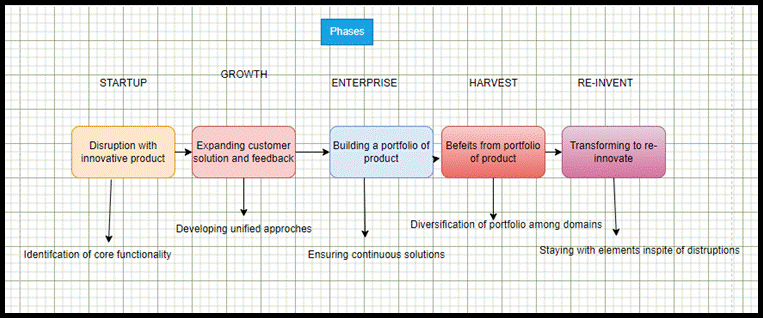
Figure 1: Project Roadmap
(Source: Self-developed)
This project roadmap provides a brief analysis of the startup with all factors that are required for this project to be completed. This shows startups with disruption with innovative technologies that analyse identification with core functionality; the next step is with growth that expands customers' solutions and feedback with development in unified approaches. The next step is with enterprises that are in building a portfolio of products that ensure continuous solutions. The 4 step is harvesting which looks at befits through that portfolio with diversifications in domains. The final step is analysed by staying with elements in spite of various disruptions.
Product Backlog of coarse granularity including Epics and User stories
|
Backlog item number |
Epic/user story |
Story Point |
Priority |
Status |
||
|
1 |
As a user, there was a need to log off the system so that there was no other person that could enter with business information and strategies used in the operation of McDonald's. |
This is based on a user that operates with an information system. |
Medium |
High |
||
|
2 |
As a user, there is a need to enter the total work hours that were dedicated to this project management, so that there is assurity of getting a salary on time. |
This is based on users that are serving for project development. This can be employees. |
Medium |
Medium. |
||
|
3 |
As an administrator, it is required to approve a spreadsheet that contains all details of employees working on this project management, in order to divide job roles. |
This is based on higher authority that looks after workers' payment and other financial aspects. |
High |
High |
||
|
4 |
As an administrator, there is a need for the creation of new accounts so that all factors that are adopted for undertaking this plan are created. |
This is based on those who deal with account maintenance. |
High |
High |
||
|
5 |
As a user, I want capabilities, so that there can access the timesheet and make changes based on project deliveries. |
This is basically with accounts managers. |
High |
Medium |
||
|
6 |
As an administrator, there is a need to run consolidated payroll reports that could make them able to provide records on weekly basis to senior authority. |
This is basically with Accounts managers. |
High |
High |
||
|
7 |
As a user, there is a need to know the advantages that will be received from adoption of digitalised methods in this company’s operations. |
This is mainly project managers. |
Medium |
Mediumn. |
||
|
8 |
As a user, there is a need to analyse competitors' strategies and make changes accordingly. |
This is basically on entrepreneurs that provide plans and provide innovativeness. |
Medium |
Medium |
||
|
9 |
As an administrator, there is a need to analyse after results of this project's deliverables. |
This is mainly managers and senior authority. |
Medium |
High |
||
|
10 |
As a user, there is a need to provide backup plans with any issue in an adopted project. |
This is mainly based on project managers. |
High |
High |
||
Table 1:Product Backlog
(Source: Self-developed)
Two Personas
Identification of epics and user stories included with Minimum Viable Product
The users that are involved in handling data and records are needed to look after factors so that their plans and data are not used by another person. A minimum viable product is the main feature that this McDonalds’ are trying to adopt in its software development. These plans are stored in systems that have good features to attract customers and also provide validation of product ideas before product development (Cuesta and B., 2019). This is adopted so that this company will get proper feedback from customers and thus can improve their strategies accordingly.
There are administrators, such as the Project Manager that will analyse the overall requirements of this project. After the completion of this plan, there is a need to check on the viability of this project's deliverables, and whether it is able to provide satisfactory results. This minimum viable product is able to provide customers with a platform where they can provide feedback to this company.
Decomposition of two epics
The handling of this data and records can be broken into two parts, as this will make them easy to analyse data and further this data could be compiled (Georges and T., 2022). This requires two accounting managers and their work is divided. These epics are necessary as this is a way of organising work and creating a hierarchy.
Project management can also be further divided. There can be two parts in which one team will look after project requirements and the other will analyse the end availability of the project, analysing whether it has met expectations.
Story Mapping for MVP200
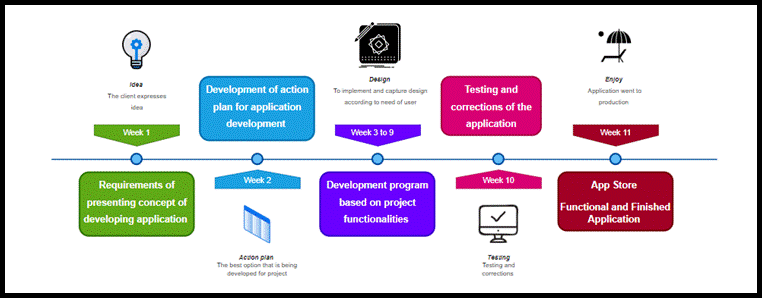
Figure 2: Roadmap of application development
(Source: Self-Developed)
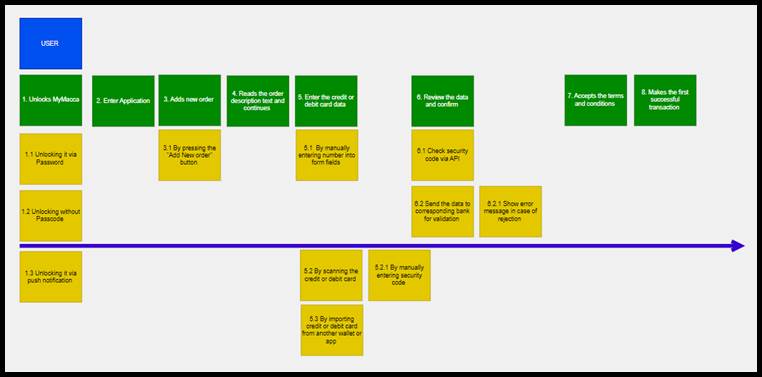
Figure 3: Story mapping for MVP 200
(Source: Self-Developed)
Story Elaboration from MVP in ensuring the user story is clear
This user story could be elaborated using MVP are additional features added to the software development process of McDonalds. This ensures that project managers are managing all requirements in this plan. There is digitalisation analysed in all aspects and this McDonalds’ is also providing a digitalized way of purchasing products, however, analysing competition in the market there are need to adopt strategies that could help in leading the market. Thus, project managers play an important role in planning and monitoring aspects that are required to be adopted (Hadibrata et al., 2021). This will also require planning a budget for the purchase of certain raw materials and goods. This will also ensure certain expenses on expenses on electricity, labour, taxes, and many more. This analysis of this budget is to be done by the financial manager and they also need to look at the payments of employees. These payments are to become on time as this will enhance
the morale of employees. The budget will be used by the project manager to allocate tasks among members according to their skills and further execute these projects. This project manager would also look at the entire team, communicate with stakeholders, and define the goals of the project and making a close view of this project (Wang et al., 2020). Then finally project manager has to analyse that this project has meet expectations and is able to provide customers with a platform where they can provide their feedback. They are solely responsible for whole undertakings.
Acceptance criteria of elaborated stories
The acceptance criteria of this project development in McDonalds’ are based on conditions that these software products are able to meet with its accepted users, systems and customers. This development will be accepted only if it provides unique services to this company. As this company is leading in the food industry, will accept such strategies that could attract more customers. In the year 2017, this company has already provided an online platform for customers known as "MyMacca's app" where customers can get their orders booked without waiting in long queues. Thus, they are looking forward to improving the experience of customers and gaining a competitive advantage through adopting new technologies such as cutting-edge technology, Artificial intelligence and many more (Medina et al., 2019). There is a need for the application of areas where customers can provide their feedback on services that this company provides this if certain changes are done
in their project, and then only these will be adopted.
Describing the mindset and role of a Business Analyst that is needed to be changed while transitioning from ‘Waterfall’ to ‘Agile’ requirement development and management practice
These changes are quite hard and are needed to plan accordingly. Being a business analyst, there is a need for organisational decisions to shit their models from the waterfall model to the agile method. This agile will be considered in working ways and is such a methodology that provides to make detailed changes in product, delivery incremental, work iterations, delivery increments, and managing uncertainties with fewer delays (Medina et al., 2019). This agile manifesto is encouraged with the following factors as
● Collaboration with customers in contract negotiation,
● Interaction and individuals in tools and processes.
● Working with software in the full documentation.
● Responding to certain changes in plan.
This is not just restricted to contact negotiation, adherence to plan and documentation, tools and process that is not required. They are less important at times of comparison with other aspects. This agile is worked with principles that is to better start quickly and iteration to flush the various requirements that could bring changes till the end of the development process (Wu et al., 2020). This methodology is not just required with one business process but is also included with the scrum master, product owner, and development team that are responsible for item backlogs, detailing, content and prioritization.
Role of Business analysts in converting "Waterfall" to "Agile"
Converting "Waterfall" to "Agile" is hard as it requires some documents for an effective transition as a business analyst development of a testing team is important. Data requirements, business requirements and specific needs of the business along with process requirements such as decomposition diagrams and business rules are required. The entire requirement has been described below in the table:
|
Business requirement |
Functional requirement |
Software requirement |
|
Purpose statement |
Scope of the design area |
Software description |
|
Scope statement |
Workflow |
External interface requirement |
|
Objectives |
Layout report |
Technical standards |
|
Risk |
User interfaces |
Program specification |
|
Challenges |
Security requirements |
Hardware description |
|
opportunity |
Quality attributes |
Technical standards |
|
Business processes |
|
|
|
Business Rules |
|
|
|
Data requirements |
|
|
Table 1: Requirements for converting "Waterfall" to "Agile"
(Source: Self-developed)
Letting go of existing templates is the first step of transition and after that development of an agile team is important. Skills of business analysts in transition include gaining clarity and understanding the needs of business stakeholders with a clear understanding of all business documents are important (Hamad & Al Fayoumi, 2018). Analyzing an agile team is important for delivering positive value and earning respect from team members. The requirement of a business including having a clear idea about probable risks and opportunities while transitioning is important for developing a risk management plan.
Conclusion
Thus, it can be concluded that with an increase in the demands and expectations of customers, there is the emergence of advanced technologies that are providing a unique service to customers. Thecustomers nowadays are more likely to purchase products through online mediums. Thus, many companies are adopting online ways to promote their products. In food industries, customers are more focused on having healthy and hygienic food. They are becoming more health conscious. McDonald's are providing services for the long term and is also a leader in such an industry. In the year 2017, this company has already provided a separate application where customers can order their food without standing in a queue. This enhanced their services and analysed an increase in customers. They are also looking forward to the competitive market that will enhance their service from others and keep their target customers. This digitalisation in their service will provide ease to
customers and they would rather like to adopt their services.
References
Hamad, R. M. H., & Al Fayoumi, M. (2018, November). Scalable agile transformation process (SATP) to convert waterfall project management office into agile project management office. In 2018 international Arab conference on information technology (ACIT) (pp. 1-8). IEEE.
Hadibrata, W., Noh, H., Wei, H., Krishnaswamy, S., & Aydin, K. (2021). Compact, High‐resolution Inverse‐Designed On‐Chip Spectrometer Based on Tailored Disorder Modes. Laser & Photonics Reviews, 15(9), 2000556.DOI:https://doi.org/10.1002/lpor.202000556
Wang, X., Zhu, L., Wu, Y., & Yang, Y. (2020). Symbiotic attention for egocentric action recognition with object-centric alignment. IEEE transactions on pattern analysis and machine intelligence.DOI: https://doi.org/10.1109/TPAMI.2020.3015894
Wu, Y., Zhu, L., Wang, X., Yang, Y., & Wu, F. (2020). Learning to anticipate egocentric actions by imagination. IEEE Transactions on Image Processing, 30, 1143-1152.DOI: https://doi.org/10.1109/TIP.2020.3040521
Cuesta, B. (2019, June). Model-based approach for agile requirements engineering using SysML and Papyrus. In Journal of Physics: Conference Series (Vol. 1257, No. 1, p. 012013). IOP Publishing.DOI: 10.1088/1742-6596/1257/1/012013
Medina, R., &Cucu-Grosjean, L. (2019, December). Work-in-progress: Probabilistic system-wide DVFS for real-time embedded systems. In 2019 IEEE Real-Time Systems Symposium (RTSS) (pp. 508-511). IEEE.DOI: https://doi.org/10.1109/RTSS46320.2019.00051
Georges, T. (2022, September). Feature and variability extraction from Agile specifications and their related source code for software product line migration. In Proceedings of the 26th ACM International Systems and Software Product Line Conference-Volume B (pp. 29-33).DOI https://doi.org/10.1145/3503229.3547065