
|
Assessment Details and Submission Guidelines |
|
|
Trimester |
T3 2022 |
|
Unit Code |
MBA512 |
|
Unit Title |
Business Data Analysis |
|
Assessment Type |
Individual |
|
Assessment Title |
Understanding Business Data Analytics: Components, Types, and Process Model |
|
Purpose of the assessment (with ULO Mapping) |
This assignment assessesthe following Unit Learning Outcomes;studentsshould be able to demonstrate their achievements in them. a) Acquire and represent structured and unstructured business data. |
|
Weight |
5% |
|
Total Marks |
50 marks |
|
Word limit |
Max 750 words, excluding references |
|
Due Date |
End of Week 3, Sunday (4/12/2022, 22:59) |
|
Submission Guidelines |
• For Assignment 1, submit as a Word document by the due date in Week 3. • All work must be submitted on Moodle by the due date along with a completed Assignment Cover Page. • For Word document, the format includes 1.5 spacing, 11-pt Calibri (Body) font, and 2 cm margins on all four sides of your page with appropriatesection headings. • Reference sources must be cited in the text of the report and listed appropriately at the end in a reference list using IEEE referencing style. |
|
Extension |
• If an extension of time to submit work is required, a Special Consideration Application must be submitted directly on AMS. You must submit this application three working days prior to the due date of the assignment. Further information is available at: https://www.mit.edu.au/about-us/governance/institute-rules-policies and-plans/policies-procedures-and-guidelines/assessment-policy |
|
Academic Misconduct |
• Academic Misconduct is a serious offence. Depending on the seriousness of the case, penalties can vary froma written warning orzero marksto exclusion from the course or rescinding the degree. Students should make themselves familiar with the full policy and procedure available at: https://www.mit.edu.au/about-mit/institute-publications/policies procedures-and-guidelines/AcademicIntegrityPolicyAndProcedure. For furtherinformation, please referto the Academic Integrity Section in the Unit Description. |
Prepared by: Prof. Paul Kwan Moderated by: Dr Mohobbot Ali November, 2022
Assignment 1 (50 Marks)
In this assignment, you are asked to draw upon your understanding of the short guide titledBusiness data analysis to answer several questions about business data analytics. While a copy ofthe guide is provided in the Assignment 1 folder on Moodle, you are welcome to read the actualguide by accessing the following web URL.
• Business data analysis
https://www.fiverr.com/resources/guides/data/business-data-analysis
This short guide on Business data analysis provides an accessible overview of different aspects ofBusiness Data Analysis, including focus areas of data analysis for a typical business, the componentsof business analytics, the major types of business analytics, a business analysis process model, andwhat the job of a business analyst would entail.
Assignment Tasks:
In Section 1 of the guide on “What is business data analysis?”, the author described 6 special areas where a typical business can utilise data analysis to gain better insights, make strategicdecisions, solve complex problems, etc. Further on, in Section 4 on “Types of business analytics”,the author presented the four types of business analytics.
a) Explain which type(s) of business analytics is/are useful to each of the 6 special areas. Note, you must include practical examples to support your answer. [6 x 4 marks]
b) For each business example included in (a), describe the kind(s) of data, including their sources and formats, you believe are useful and should be collected. [6 x 4 marks]
c) Use proper referencing. [2 marks]
For your assignment, you might consider presenting your answer in a table where rows in the firstcolumn correspond to the 6 special areas, the second column explains for each special area whichtype(s) of business analytics is/are suitable, while the third column describes for each businessexample the kind(s) of data you believe are useful and should be collected.
The word limit is 750 words, excluding additional references.
You can use Internet search to find resources to support your discussion and explanation. However, you must cite any source according by using the APA referencing style
(https://library.mit.edu.au/businessreferencing).
Marking criteria:
The following marking criteria will be used.
Assignment 1
|
Sections to be included in the assessment |
Description of the section |
Marks |
|
1) 2) 3) |
Explain which type(s) of business analytics is/are useful for each of these 6 special areas. Note, you must include real businessexamples to support your answer. (4 marks x 6) For each business example included in (a), describe the kind(s)of data including their sources and formats you believe areuseful and should be collected. (4 marks x 6) Include proper referencing |
24 24 2 |
|
Total |
50 |
Example Marking Rubric for Assignment 1: Total Marks 30
|
Grade Mark |
HD 27-30 |
DI 23-26 |
CR 19-22 |
P 15-18 |
Fail <15 |
|
Excellent |
Very Good |
Good |
Satisfactory |
Unsatisfactor y |
|
|
Explain which type(s)of business analytics is/are useful for each of the 6 specialcases. / 24 |
Concise and accurate explanation |
Relevant and sound explanation |
Generally relevant explanation |
Some relevance explanation |
Explanationare not relevant |
Prepared by: Prof. Paul Kwan Moderated by: Dr Mohobbot Ali November, 2022
MBA512 Business Data Analysis 4 of 7
|
Grade Mark |
HD 27- 30 |
DI 23-26 |
CR 19-22 |
P 15-18 |
Fail <15 |
|
Describe thekind(s) of data including their sourcesand formatsyou believe are useful and should be collected. / 24 |
Clear and Concise |
Mostly clear and concise |
Mostly clear and adequately concise |
Mostly clear but not concise |
Not clear andnot concise |
|
Include proper referencing. / 2 |
Clear and proper referencing |
Mostly clearand proper referencing |
Often clear and proper referencing |
Some properreferencing |
Lack proper referenc ing |
BUSINESS DATA ANALYSIS
1. Introduction
In the case of this project, the discussion has been made on business data analytics which has been used here to analyze the business data and develop the overall strategy of the business with the use of major areas. It has been seen from the project that the scholar has used the 6 major areas to develop the data analysis process. The research has said that the developer has developed a model to evaluate the business analytics process.
2. Business analytics process
Business analytics is a process where the statistical method has used to analyze historical data. To gain new insights and develop the overall strategy the data analysis process is to be used. The effective approaches are to be used here to develop the technological analyzing process. It has seen from the project that the business analytics process has been improved the strategic decision-making system. Here the various kinds of areas are to choose here to develop the analysis procedure step by step. The research has said that the business analytics process is performed in this scenario to identify the business problem and also to mitigate the problems the current agenda has played an effective role. The coherent method is to be used in this segment to analyse the business data with the use of the business analytics process.
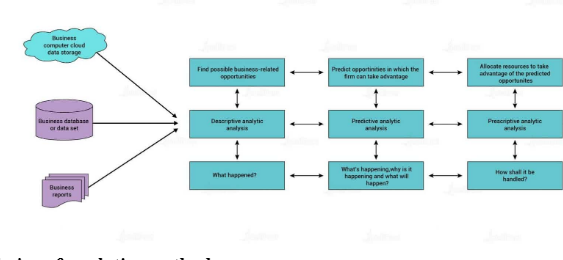
Figure 2.1: Business analytics process
(Source: Business.com, 2020)
3. Choice of analytics method and sources
In this project, the developer has chosen various kinds of steps or areas to develop the business prospects. Here the developer has chosen the business analytics process to develop the business solution and also reaming analytics process has made correct decisions to develop an integrated business [3]. Here various kinds of analytics method have been used to anticipate customer need as well as develop a solution to transform valuable insights. The 6 used full areas have been chosen in this section to evaluate the project that is
Step 1: Identified the problem
Here the developer has identified the data to develop valuable metrics. It has been seen that the scholar has used the business analytics process to address the business-related problem and also the remaining analytics process has been used to solve the problem. The remaining techniques are implied in this section to clearly understand the smaller goals of the business and analyse crucial stages to evaluate the outcome.
Step 2: Exploring data
Here the scholar has defined the problem statement and stored the data to develop the exploring process. It has been seen that the developer has cleaned the data to develop the analytics process [2]. All data points are to be coherently analysed to empty the data points or Jung's data points.
Step 3: Analysis
In this segment, the developer has chosen the analysis process to analyse the business data. It has seen from the project that the developer has been chosen the statistical analysis method to analyse the outcomes, as well as hypothesis testing, which has used to mitigate the business problem and the current analysis process has coherently analysed the data points to develop the variables.
Step 4: Optimization and prediction
The proactive business data has been used in this scenario to develop the optimization process. It has been seen that the developer can be used the neural network or decision tree to make the correct prediction. The business data has been optimized properly to develop the prediction process [1]. The business trends have mainly been predicted in this project to understand the future business trend.
Step 5: Evaluating the correct decision to o understand the outcomes
In this segment, various kinds of the effective method have been used to evaluate the correct decision and also the optimization and prediction process can be used in this segment to evaluate the business outcomes. Here the developer has used the appropriate agendas to make the right decision to develop the business goals.
Step 6: Updating and optimising
Here the developer has optimised the solution to get better outcomes. The applicable agendas have been used here to upgrade the performance of the business as well as the potential identification to address the business problem.
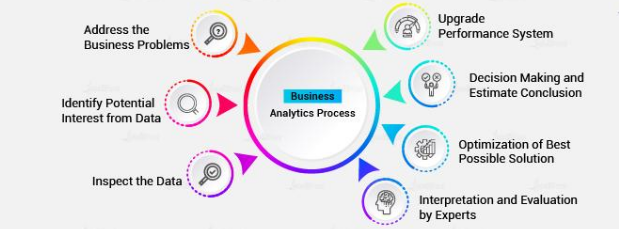
Figure 3.1: 6 areas of the business analytics process
(Source: Intellipat.com, 2020)
4. Conclusion
In the case of this project, the scholar has used effective agendas and methods to conclude the project. The 6 steps are to be followed in this section to make the right decision as well as the practical example has mentioned in the steps to evaluate the better outcome. It has been seen from the project that the developer has used a data-driven analytics process to anticipate customer choices and needs also it has evaluated business solutions to develop valuable insights.
References
[1]Mikalef, P., Pappas, I., Krogstie, J. and Pavlou, P.A. eds., 2020. Big data and business analytics: A research agenda for realizing business value.
[2]Akter, S., Michael, K., Uddin, M.R., McCarthy, G. and Rahman, M., 2020. Transforming business using digital innovations: The application of AI, blockchain, cloud and data analytics. Annals of Operations Research, pp.1-33.
[3]Raut, R.D., Mangla, S.K., Narwane, V.S., Gardas, B.B., Priyadarshinee, P. and Narkhede, B.E., 2019. Linking big data analytics and operational sustainability practices for sustainable business management. Journal of cleaner production, 224, pp.10-24.