
|
Assessment Brief |
|
|
Program
|
Bachelor of Applied Social Science |
|
Subject
|
Human Development Across the Lifespan |
|
Subject code |
COU103A |
|
Name of assessment |
Assessment 3 – Report |
|
Length |
1500 words |
|
Learning outcomes addressed by this assessment: |
A, B, C, D, E |
|
Submission Date: |
End of Week 11, Sunday 11.55 pm |
|
Assessment brief summary: |
This assessment is a report. Scroll down to find further de tails of the assessment requirements. |
|
Total marks |
40 |
|
Weighting
|
40% |
|
Students are advised that any submissions past the due date incur a 10% penalty per day, calculated from the total mark e.g., a task marked out of 40 will incur a 4-mark penalty per day.
Participating in the forum discussion is mandatory. Please note that you must attempt all tasks in a subject to be eligible to pass the subject.
For more information, please refer to the Academic Progression Policy at
http://www.torrens.edu.au/policies- and-forms. |
|
Assessment Description: Report
“Secure attachment was once viewed as important for infant development. More re- cently, it has been deemed the most important ingredient for successful relationship formation, strong self-identity & confidence to function and achieve in our lifetime.”
Please discuss the above statement.
You will need to examine and review the developmental theory literature on this statement. This will include researching early work around attachment however you are expected to extend this research to the adult attachment theories that emerged in the 80’s that stem from earlier attachment theory.
Using your research to support your arguments, discuss the above statement. Your report should arrive at a conclusion based on your research.
Marking Criteria:
|
|
Max. in
category |
Your
points |
|
Comprehensive literature review on issue |
10 |
|
|
Life span development / attachment theory identified and explained |
10 |
|
|
Analysis and examination of theory & argument established |
10 |
|
|
Number and choice of appropriate references |
4 |
|
|
Correct referencing style: in‐text references and reference list |
3 |
|
|
Word count, readability and essay structure used |
3 |
|
|
TOTAL: |
40 |
|
|
Comments |
||
Referencing
It is essential that you use appropriate APA style for citing and referencing research. Please see more informationonreferencinghereat
https://laureate
au.blackboard.com/webapps/blackboard/content/listContent.jsp?course_id=_20163_1&content_id=_249884 7_1&mode=reset
Submission Instructions
Save your report using the following naming convention: POA612_A_Jones_Assessment_1.pdf Submit your report via the Assessment link in Blackboard. Your Learning Facilitator will provide feedback via the Grade Centre. Feedback can be viewed in My Grades.
Academic Integrity
The work you submit for this assessment task must be your own and align with the Torrens University Australia Academic Integrity Policy and Procedure. Before submission, please make sure you have read and are aware of this policy, viewable online at http://www.torrens.edu.au/policies- and-forms.
Also, please keep a copy of all submitted material and your drafts.
ASSESSMENT 3 – REPORT
Executive summary
Early life experiences of a child are important for further development and the style of attachment and parental responsibilities plays a crucial role in the development of a child's social and physical well-being. According to "Bowlby's Attachment theory" lack of secure and healthy relationships can result in violence and psychopathic behaviour. A child with a secure and healthy realisation develops normal mental and physical growth. Playful relations with affection also help parents to develop a strong relationship with children that make m confident and able to handle situations easily. People from secure backgrounds develop strong bonding and learn to give value to other relationships in their later life.
Introduction
Early life experiences of a child are important for developing their later skills and largely influence their mental maturation. A child's experiences in early life help in the development of their emotional stability, intelligence, cognitive skills, and social skills and build personality. This stage is vital for developing attachment which is a corresponding bond between parents and infants. Such types of attachment are important for the adoption of values that determine the growth of a child into adulthood. Attachment between parents and infants can be subcategorised into secured and insecure attachment, Secured attachment serves as an effective model for developing future relationships with children and helps to engage and interact with them. A positive relationship can be developed if the child felt confident and safe in their attachment. According to some scholars, securely attached infants show
greater enthusiasm in comparison to insecure children.
Review of development theory
Development theories are essential in understanding the growth of human babies and provide insight and knowledge about their behaviours. These theories provide great perspicuity about society and individuals. The development of Children is often neglected and research on development theories helps in understanding the different changes that take place when the child developed from infancy to adulthood (Granqvist, 2021). Development theories support a child's behaviour changes due to unconscious desires and early life experinces of the child. The development of a Child takes place at early stages and development theories help in understanding behavioural changes among infants. "The Bowlby's Attachment theory" provides great insights into early relationships and social relationships among infants and their parents (Jarvis, 2020).
This theory helps children receive protection and care from their parents. According to this theory, secured attachment between parents and infants helps in survival as it ensures both the developmental and motivational development of the child. According to Stroebe (2021), Four characteristics such as "Separation distress", "Proximity maintenance", "Stable base" and "Haven" helps in the development of the relationship between the infant and caregiver. According to this theory child's development partially and sometimes totally depends on attachment to a caregiver.
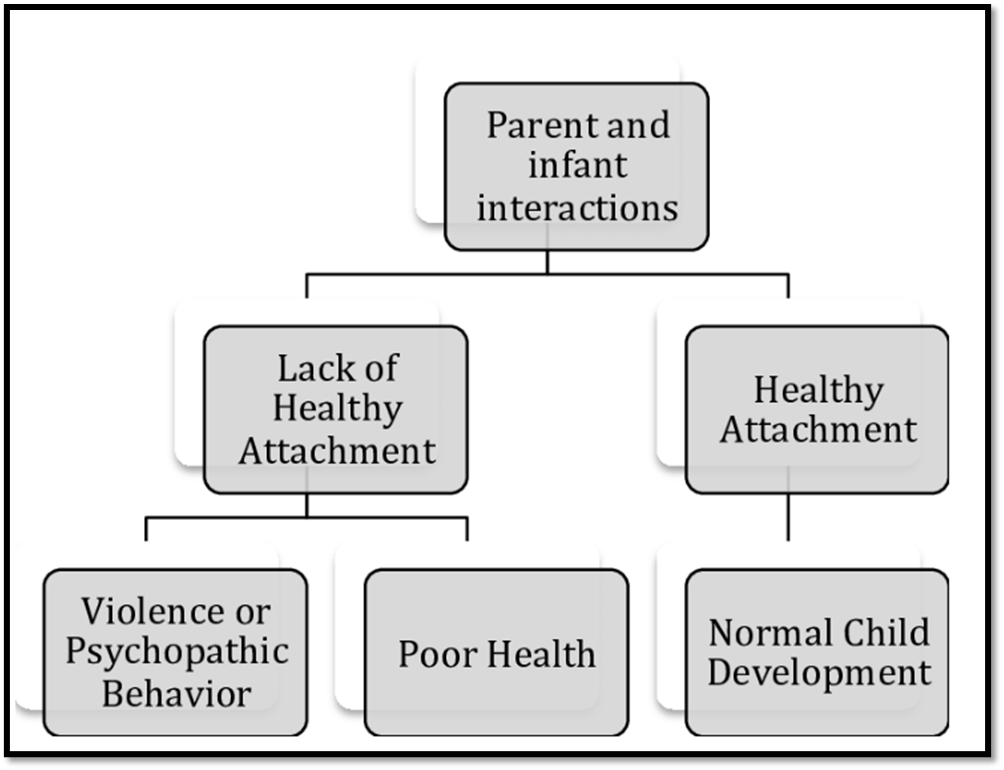
Figure: "The Bowlby's Attachment theory"
(Source: Researchgate.net, 2022)
The above figure shows the reflection of "Bowlby's Attachment theory" which that indicates a lack of healthy or secure attachment can result in violence or psychopathic behaviour among infants with poor mental along with physical health of a child. On the other hand, Healthy affection with the caregiver drives into normal development of the child (Stroebe, 2021). Among adults attachment toward infants can be evidence that helps in understanding a child's further development. Secured attachment between mother and child and infant help in social, emotional and cognitive development and according to this theory if a child is detached from the mother then the infant has a chance of poor development and maladjustment in future (Jarvis, 2020). The average age of developing attachment between parent and infant is 18 months and
children develop anxiety about strangers. At this stage, children started to know people and attached to their caregivers. After 10 months infants become strongly dependent and formed attachments with their parents.
Individuals show different features and characteristics toward attachment theory and attachment styles differ according to the age of infants. The pattern of attachment in 12 to 18 months regulates negative emotions and very crucial time for developing attachment (Choate et al. 2019). According to recent studies, the adult relationship varies depending on the secured attachment and styles are closely linked with the level of satisfaction in a relationship (White & Gibson, 2019). It can be proven that people who have securely attached show comfort and confidence in the relationship and people with insecure attachment show anxiety and discomfort in relationships. Attachment is an important interaction skill that is important for influencing people's behaviours and determining the
way they can express their feelings (Steele, 2018). Attachment theory provides deep concern about a person's ability to maintain intimate bonds and develop sustainable relationships and ultimately desire to make secured attachments at individual levels.
Importance of secure attachment
Secure attachment can be determined as an essential ingredient for developing effective relationships and helps children to grow up strong. According to attachment theory, a secure attachment at the infant stage helps a child develops Successful relationship although their lifetime. Secured attachment is crucial for developing confidence and a good personality while insure attachment has a possibility to develop maladaptive behaviour among children in later life (Van IJzendoorn & Bakermans-Kranenburg, 2021). In secured attachment child and mother bonding is important for further development. A child who feels secure in unknown places have parents who response to all their needs and develops the healthy relationship in their adulthood. Secure attachments help adults to develop good relationships with values and easily connect to other people (Forslund et
al. 2022). Secure attachment helps the child to develop stability in relationships along with confidence and self-esteem.
Secured attachment helps to develop emotional bonding, friendship and confidence in later life. A secure bond between parent and infant helps in developing a wordless emotional exchange and ensures that the child feels safe and secure. This secure feeling helps in the optimal development of the nervous system and attaches the baby to its caregiver. This health relation helps in increasing eagerness among children, trust and self-awareness among infants.
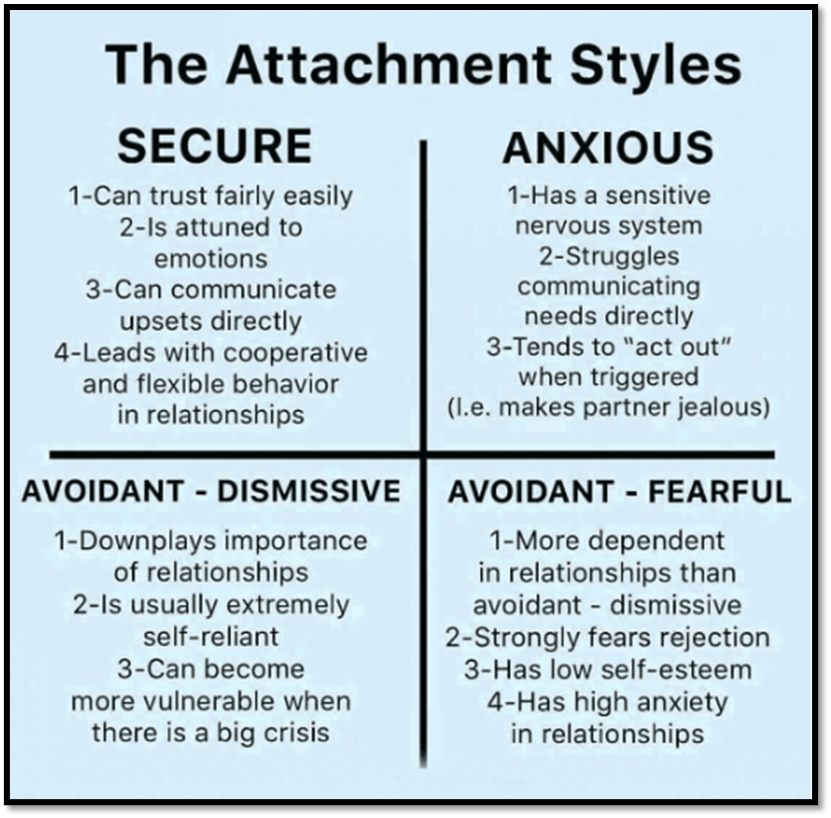
Figure 2: Types of attachment styles
(Source: Practicalpie.com, 2022)
The above figure shows four types of attachment styles including "Secure", "Anxious", "Avoidant-dismissive" and "Avoidant-fearful". Secured styles help the child to trust easily and provide flexibility in a further relationship. "Anxious" style results in a sensitive nervous system and "Avoidant-dismissive" can become vulnerable when a great crisis arises. "Avoidant-fearful" results in low self-esteem with high anxiety in a relationship and strong fear of rejection. Secured attachment is crucial for the development of the brain which is responsible for the emotional and social development of a child. Such a strong bond and relationship between child and caregiver becomes the foundation that provides the child with the ability to connect with others. The social development of infants includes understanding, love, empathy and the ability to respond. The development of secured attachment helps in
developing intimate relationships and emotional balances. The child started to feel confident and enjoy being with others through the development of secured attachment with their parents or caregivers.
Development of secured attachment takes time and ongoing parenting between parents and baby is important for forming secured attachment. Understanding the signs of a baby and providing them rest, food, love, affection and comfort helps in developing a secure attachment. Watching the facial experiences of babies helps in identifying sensory needs and becoming familiar with babies makes them comfortable.
Role of secure attachment in developing Confidence
A secure child feels more happiness and less anger which helps them to become socially effective and the development of problem-solving skills with a calm mind has taken place during the early stage of life. Parental skills and types of attachment between parents and children are essential while the development of confidence in children. Parents showing affection and love toward infants help children to become comfortable and protected feeling again helpless or hopeless about life. A strong bond and secure attachment help children to believe in their parents which increase their confidence (Choate et al. 2019). Communication with the child increases self-esteem and improves belief in them. A secure relationship with a child delivers a healthy relationship between the infant and caregiver or parents that allow the child to explore. Children feel safe and
they become able to explore new things and share them it their parents which helps in their personal growth along with skills such as communication, problem-solving and active thinking.
Insecurely attached children develop fewer social skills compared to securely attached children and have lower levels of communication styles. People from insecure backgrounds developed high stress and anxiety which provides a very powerful stimulus of emotional distress. Lack of inability to speak confidently is common in insured children while in secured children confidence level is high due to the high level of communication skill that has been developed due to secured attachment maturation with parents. Hence secured attachment development between parents and infant is crucial for improving communication skills along with interaction with others that provides confidence and helps in developing strong relationships in future.
Conclusion
It can be concluded from the above report that the early life experiences of a child are important for the development of children. The theory of Bowlby's Attachment helps to understand insights on parenting practising in providing secured attachment and the negative impacts of insecure attachments. Responsive care from parents helps in the optimal growth of a child which helps to determine the level of confidence, self-esteem and communication skills in later life. A secure relationship helps the child to develop confidence and developing stable relationships with high rates of flexibility. Such charters of a child fully depend on parental responses rather than become genetic results. Highly insecure individuals encounter high stress and threats and they are poor at making relationships. People having an insecure attachment fear rejection and highly avoid their work along with relationships.
Reference
Books
White, S., & Gibson, M. (2019). Reassessing attachment theory in child welfare: A critical appraisal. Policy Press.
Journals
Choate, P. W., Kohler, T., Cloete, F., CrazyBull, B., Lindstrom, D., & Tatoulis, P. (2019). Rethinking Racine v Woods from a decolonizing perspective: Challenging the applicability of attachment theory to Indigenous families involved with child protection. Canadian Journal of Law and Society/La Revue Canadienne Droit et Société, 34(1), 55-78. Retrieved from:
https://www.researchgate.net/profile/Peter-Choate-2/publication/333052841_Rethinking_Racine_v_Woods_from_a_Decolonizing_Perspective_Challenging_the_Applicability_of_Attachment_Theory_to_Indigenous_Families_Involved_with_Child_Protection/links/62bcc60060e77b7db83d2cde/Rethinking-Racine-v-Woods-from-a-Decolonizing-Perspective-Challenging-the-Applicability-of-Attachment-Theory-to-Indigenous-Families-Involved-with-Child-Protection.pdf
Forslund, T., Granqvist, P., van IJzendoorn, M. H., Sagi-Schwartz, A., Glaser, D., Steele, M., ... & Duschinsky, R. (2022). Attachment goes to court: Child protection and custody issues. Attachment & Human Development, 24(1), 1-52. Retrieved from: https://www.tandfonline.com/doi/pdf/10.1080/14616734.2020.1840762?needAccess=true&fbclid=IwAR3km-qtinIKBrhv11QiGbNmJMoTxRaQBEINO3pvSJ8EADLCjvJ4x6e4PrQ
Granqvist, P. (2021). Attachment, culture, and gene-culture co-evolution: expanding the evolutionary toolbox of attachment theory. Attachment & Human Development, 23(1), 90-113. Retrieved from: https://www.tandfonline.com/doi/pdf/10.1080/14616734.2019.1709086
Jarvis, P. (2020). Attachment theory, cortisol and care for the under-threes in the twenty-first century: constructing evidence-informed policy. Early Years, 1-15. Retrieved from: https://www.tandfonline.com/doi/pdf/10.1080/09575146.2020.1764507
Steele, M. (2018). The “added value” of attachment theory and research for clinical work in adoption and foster care. In Creating New Families (pp. 33-42). Routledge. Retrieved from: http://students.aiu.edu/submissions/profiles/resources/onlineBook/p7t6f5_Families_Therapeutic_Approaches_to_Fostering_and_Adoption.pdf#page=56
Stroebe, M. (2021). The Study of Security and Separation: An Unexpected Forerunner of Attachment Theory?. OMEGA-Journal of Death and Dying, 84(1), 146-156. Retrieved from: https://journals.sagepub.com/doi/pdf/10.1177/0030222819880706
Van IJzendoorn, M. H., & Bakermans-Kranenburg, M. J. (2021). Replication crisis lost in translation? On translational caution and premature applications of attachment theory. Attachment & human development, 23(4), 422-437. Retrieved from: https://www.tandfonline.com/doi/pdf/10.1080/14616734.2021.1918453https://www.tandfonline.com/doi/pdf/10.1080/14616734.2021.1918453https://www.tandfonline.com/doi/pdf/10.1080/14616734.2021.1918453
Websites
Practicalpie.com, 2022 Types of attachment styles [online] Available at: https://practicalpie.com/attachment-styles-theory/ [Accessed on 23rd November, 2022]
Researchgate.net, 2022 "The Bowlby's Attachment theory" [online] Available at: https://www.researchgate.net/figure/Bowlbys-Attachment-Theory_fig1_263270117 [Accessed on 23rd November, 2022]